The Economy Grew 4.3%. Small Business Bankruptcies Rose 43%. Here's What I'm Watching.
The national numbers look great. Main Street is dealing with pricier money, new tariffs and careful customers, with a Fed hike likely next.

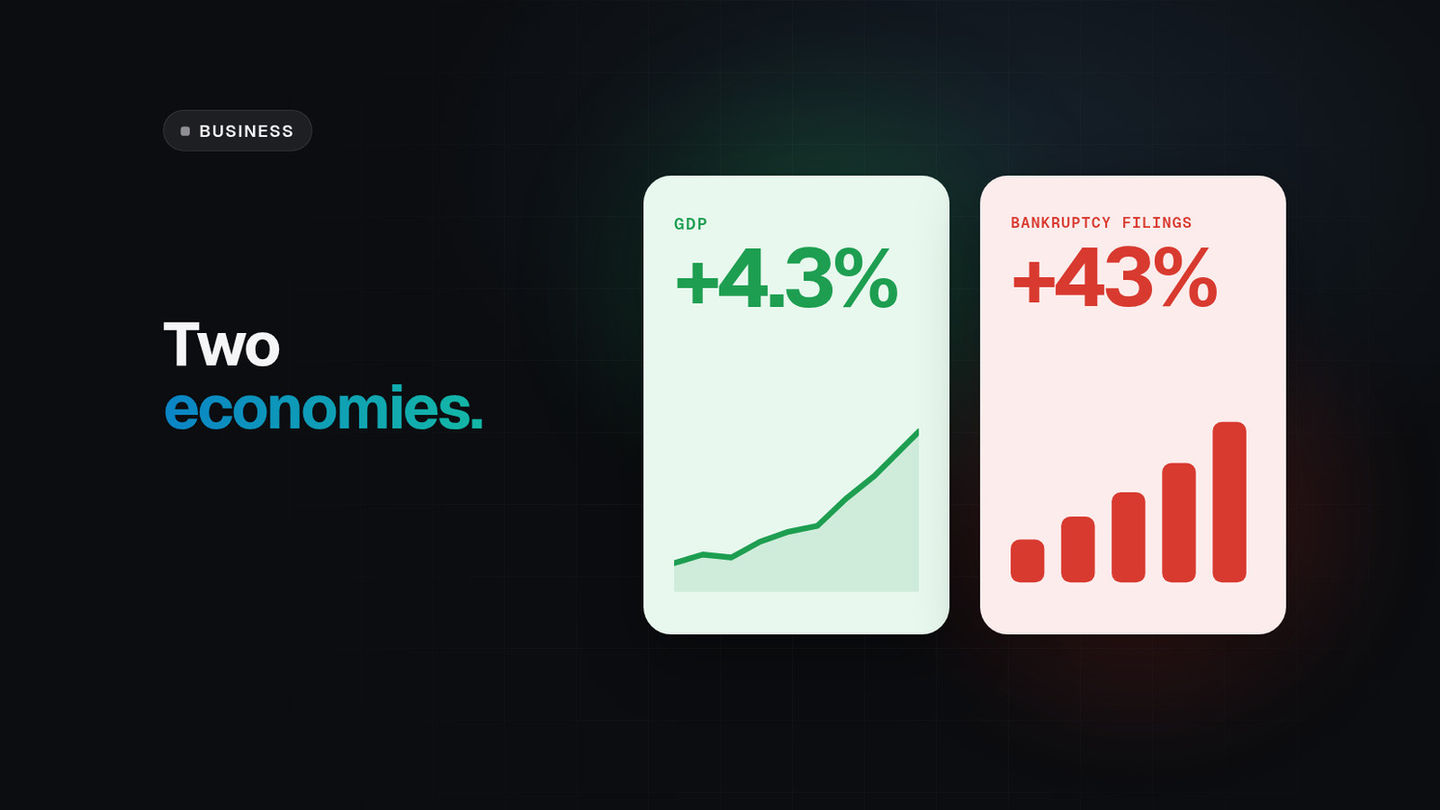
Two numbers came out this week that don't seem like they belong in the same country.
On Wednesday, the government said the U.S. economy grew at a 4.3% annual rate in the third quarter. That's up from the 3.4% first reported, and nearly double the 2.2% pace in the second quarter (BEA, Nov. 25, 2026). On Thursday, a different number made the rounds: small business bankruptcy filings under Subchapter V are up 43% from the same period last year, from 1,890 to 2,701 through October, according to bankruptcy data provider Epiq AACER (Spectrum News, Nov. 27, 2026).
Both are true at the same time. Both matter to anyone who runs a small business. And I think the gap between them is the most important thing to understand going into 2027.
What's actually growing
Look at what drove that 4.3%. Axios reported that the upward revision came from stronger business investment, driven by the AI buildout and software, along with consumer spending (Axios, Nov. 25, 2026). A measure of underlying private demand rose at a 5.8% rate.
That's real growth. But a lot of it is big companies spending big money on data centers, chips and software. That's not the same economy as a martial arts studio, a lawn care crew or a family restaurant.
The same day's data showed the other side. Inflation-adjusted consumer spending stalled in October. The Fed's preferred inflation gauge, PCE, rose to 3.8% from a year earlier, and core inflation sped up to 3.3% (Axios). People made more money in October, but they saved more of it instead of spending it. The saving rate rose to 4.1% from 3.6%.
When customers get careful, small businesses feel it first.
What's squeezing small businesses
Spectrum News profiled an Atlanta martial arts studio owner who said he's "doing barely enough to keep the lights on." His story covers most of the pressure points I keep hearing about:
- Input costs. He said a box of breaking boards went from $55 to $120 after tariffs hit his Chinese suppliers. The Supreme Court struck those tariffs down, but the price increases had already landed.
- Energy and shipping. He said the war in Iran pushed up his shipping costs through higher fuel prices.
- Customers pulling back. Small Business Majority's Alexis D'Amato Falvey told Spectrum that "nonessential" businesses are being hit hardest, because they're the first thing families cut.
To be fair, the White House points the other way. A spokesman told Spectrum that the administration's agenda has helped small businesses through lower taxes and less red tape, and an official noted more than 5.5 million new business applications this year. I believe both things. People are still starting businesses. More of the ones already running are hitting a wall.
The three things I'm watching
1. The Fed meeting on Dec. 8-9
The Fed held its benchmark rate at 3.75% to 4% in October, with two officials voting to raise it (Federal Reserve, Oct. 28, 2026). Now markets are pricing in a hike. As of Tuesday, CME's FedWatch tool showed a 97% chance of a quarter-point increase at the December meeting (CNBC, Nov. 25, 2026).
A strong GDP number gives the Fed more room to do that. For small businesses, a hike means credit cards, lines of credit and equipment loans get more expensive, usually within a billing cycle or two. It also lands on customers. CNBC noted Americans are carrying a record $1.29 trillion in credit card debt heading into the fourth quarter. Moody's Analytics' Cristian deRitis told CNBC that lower-income and younger households leaning on credit cards "will feel the pinch."
Those are a lot of the customers local service businesses depend on.
2. A new round of tariffs
On Wednesday, the U.S. Trade Representative proposed new Section 301 tariffs on 14 economies, including China, the EU, Japan, Korea, Vietnam and India (USTR, Nov. 25, 2026). For China, the proposal is tariffs of up to 20% on most goods.
These aren't in effect yet. Written comments are due Jan. 5, 2027, and hearings start Jan. 25. That timeline matters. If you buy equipment, parts or inventory from overseas, you have a window to plan, and a window to tell USTR how it would hit you. Small businesses rarely show up in those comment dockets. We should.
3. How customers actually feel
The University of Michigan's consumer sentiment index rose to 51.5 in November from 48.0 in October, but it's still 9% below February, before the Iran conflict started (University of Michigan, Nov. 2026). The survey's director, Joanne Hsu, wrote that consumers "continue to report overwhelmingly that inflation—rather than unemployment—will cause greater hardship" over the next year or two.
That's the mood your customers bring to every quote you send. They're not broke. They're careful. They're comparing more and waiting longer.
What I'm doing about it
I'm not going to pretend I have it figured out. FullerSphere is a small company too, and I'm 24. But here's how I'm thinking about the next few months, for us and for the businesses we work with:
- Pay attention to variable-rate debt. If a credit card or line of credit is floating, assume it gets more expensive in December and plan around that.
- Don't race to the bottom on price. Careful customers want proof, not discounts. Clear pricing, real reviews and a website that answers their questions do more than a coupon.
- Know your supply chain. If anything you buy comes from one of those 14 economies, find out now, not in February.
- Watch cash, not just revenue. The headline economy can be booming while your bank account isn't. I'd rather have three months of runway than a great-looking quarter.
A 4.3% economy is good news. I just don't want anyone confusing it with good news for their business. The national numbers are being carried by companies spending billions on AI. Main Street is running on tighter margins, pricier money and more careful customers. That's the economy I'm planning for.
Sources
- U.S. Bureau of Economic Analysis, "GDP (Second Estimate) and Corporate Profits, 3rd Quarter 2026," Nov. 25, 2026: https://www.bea.gov/news/2026/gdp-second-estimate-and-corporate-profits-3rd-quarter-2026
- Axios, "U.S. economy grew at rapid 4.3% pace in third quarter, new estimate shows," Nov. 25, 2026: https://www.axios.com/2026/11/25/economy-gdp-inflation-ai
- Spectrum News, "More small businesses declare bankruptcy amid tough economic headwinds," Nov. 27, 2026: https://spectrumlocalnews.com/us/snplus/news/2026/11/27/small-business-bankruptcy-rise-
- CNBC, "The Fed is likely to raise rates in December. What it means for your holiday spending," Nov. 25, 2026: https://www.cnbc.com/2026/11/25/fed-december-rate-hike-consumer-impact.html
- Federal Reserve, "Federal Reserve issues FOMC statement," Oct. 28, 2026: https://www.federalreserve.gov/newsevents/pressreleases/monetary20261028a.htm
- Office of the U.S. Trade Representative, "USTR Makes Determinations and Proposes Actions in 14 Section 301 Investigations," Nov. 25, 2026: https://ustr.gov/about/policy-offices/press-office/press-releases/2026/november/ustr-makes-determinations-and-proposes-actions-14-section-301-investigations-relating-structural
- University of Michigan Surveys of Consumers, "Final Results for November 2026": https://www.sca.isr.umich.edu/
Keep reading
All articles

One email. Every Sunday.
The week in business, markets and politics, in five minutes.