The Biggest Bank Failure in Two Years Happened on Black Friday. Here's What I'm Watching.
Depositors at United Fidelity Bank are fine. But how a fast-growing bank bet almost everything on one kind of loan is a lesson every small business owner should take.

While most of us were sleeping off Thanksgiving or standing in a checkout line, federal regulators closed a bank.
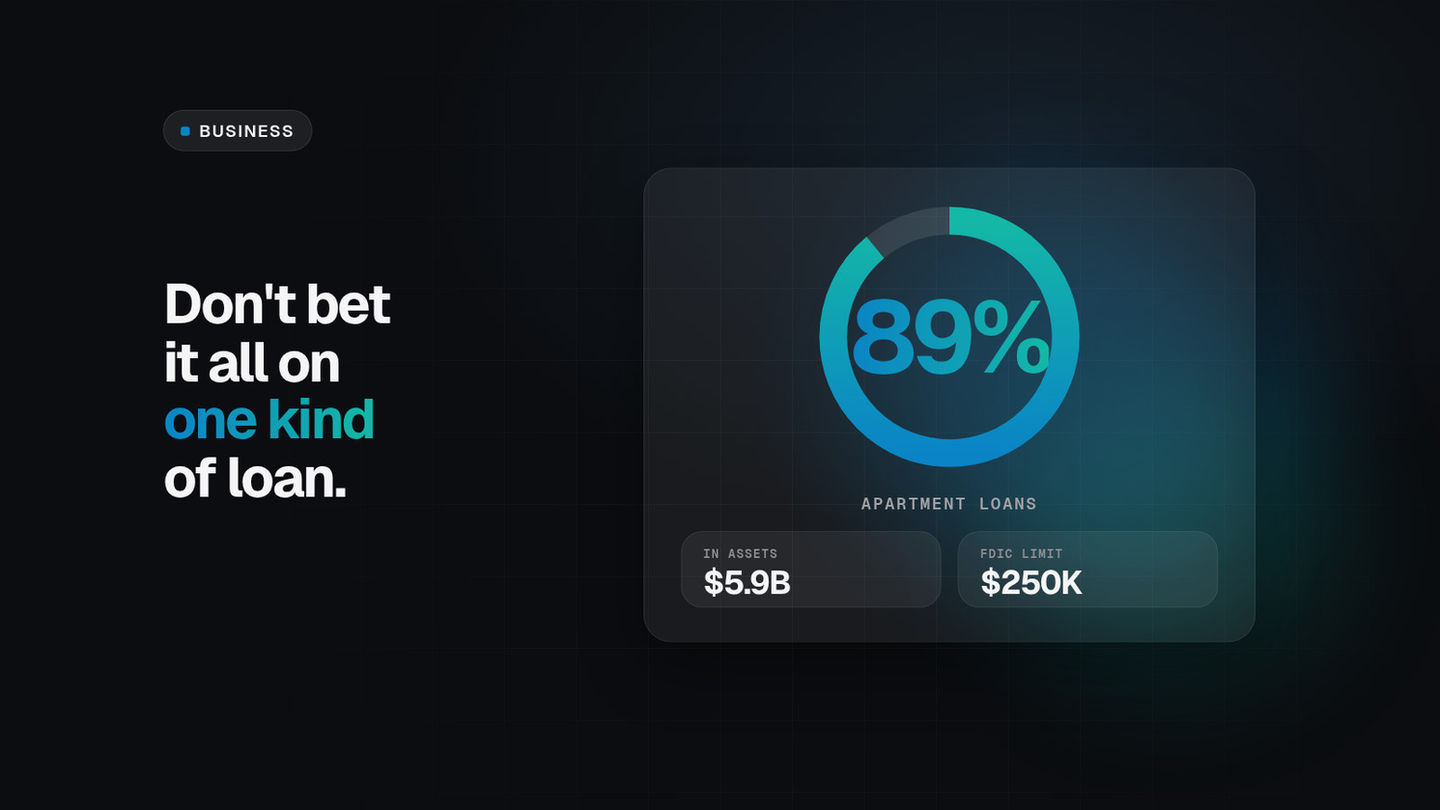
On Friday, Nov. 27, the Office of the Comptroller of the Currency shut down United Fidelity Bank, a savings bank based in Evansville, Indiana, and handed it to the FDIC. The OCC said the bank was "in an unsafe or unsound condition to transact business" and likely couldn't pay its obligations or meet depositors' demands (OCC, Nov. 27, 2026). It had about $5.9 billion in assets and $5.4 billion in deposits. The Associated Press called it the biggest U.S. bank failure since 2024 (AP, Nov. 28, 2026).
The good news first: if you banked there, your money didn't disappear. The FDIC sold the bank to First Citizens Bank of Raleigh, North Carolina, the same bank that bought Silicon Valley Bank out of receivership in 2023. Depositors became First Citizens customers overnight. Cards, checks and direct deposits kept working, and the bank's 22 branches in Indiana, Illinois, Florida, Colorado and the U.S. Virgin Islands started reopening under the First Citizens name on Saturday (FDIC, Nov. 27, 2026).
So this isn't a panic story. But I don't think small business owners should scroll past it, either. A bank failure is one of the clearest lessons you'll ever get in what risk looks like when nobody's paying attention.
How a bank gets here
The details are in the bank's own filings, and they're rough. According to The Bank Slate's read of United Fidelity's Sept. 30 call report, the bank lost $249.6 million in the first nine months of 2026 and charged off $362.6 million in loans, almost all of them apartment loans (The Bank Slate, Nov. 2026). Multifamily loans made up 89% of its loan book. By the end of September, 71% of all its loans were on nonaccrual, meaning the bank no longer expected to collect interest on them as usual. Its total capital ratio was 7.26%, under the 8% minimum for a bank to count as adequately capitalized, and it had set aside just $6.3 million for loan losses.
It also wasn't a surprise to regulators. Back in October 2023, the OCC put the bank under a consent order and labeled it in "troubled condition," citing weak board and management oversight, capital planning, credit review and internal controls. In June 2024, the Federal Reserve reached a written agreement with the bank's parent companies over capital planning, risk management and contingency funding (The Bank Slate).
At the time, the bank's position was basically that it was growing too fast for its regulator's comfort. A bank spokesperson told the local paper in 2024 that it had made about $200 million in profits over two years, "well in excess of our peer banks" (Current, Nov. 28, 2026). The bank was owned by Pedcor, an Indiana apartment developer.
Put that together and you get a bank that was very profitable, very fast, by betting almost everything on one kind of loan. Until it wasn't.
Why I think this matters for Main Street
I'm not writing this because I think your bank is about to fail. Most banks aren't anything like this one. I'm writing it because the mistake that sank United Fidelity is the same one I see small businesses make all the time, just at a smaller scale.
Concentration feels great right up until it doesn't. 89% of one bank's loans in one category is the banking version of a landscaping company where one property manager is 70% of revenue, or an agency like mine where one big client pays most of the bills. The numbers look amazing while that customer is happy. Then one email changes everything.
It's the risk I think about most at FullerSphere. A roster where no single client can sink you looks less exciting on paper, but it's a lot easier to sleep on.
Warnings tend to show up years early. Regulators flagged this bank in 2023. It failed in 2026. Most business problems work the same way. The slow-paying customer, the margin that shrinks a little every quarter, the bookkeeping you keep meaning to clean up. None of it is an emergency today. That's exactly why it gets ignored.
What I'm watching
1. Whether more apartment-heavy lenders crack
United Fidelity's problem was multifamily real estate. I'm not going to guess about other banks without data, but I'll be watching whether this is a one-off tied to one owner and one strategy, or the first of several lenders with heavy apartment exposure to run into trouble. That matters for anyone who needs a commercial loan in 2027, because when banks get nervous about real estate, credit tends to get tighter for everybody.
2. The cost and who covers it
The FDIC estimates this failure will cost its Deposit Insurance Fund $1.83 billion (FDIC). First Citizens' winning bid included an asset discount of about $2.6 billion and no deposit premium (First Citizens, Nov. 27, 2026). The fund is paid for by assessments on banks, and over time those costs work their way into what banks charge. I want to see how regulators talk about this one in the weeks ahead.
3. Brokered deposits
One detail worth knowing: First Citizens took on about $4.5 billion of the bank's deposits, not all $5.4 billion. The FDIC said "certain brokered deposits" weren't part of the deal, and The Bank Slate noted the call report showed about $1 billion in brokered deposits (The Bank Slate). If you park cash through a brokerage sweep or a CD you bought from a broker, it's worth knowing which bank actually holds it.
What I'd do this weekend
None of this takes long, and it's the kind of thing you only think about after a headline like this:
- Know your $250,000 line. Per the FDIC, all deposits owned by a corporation, partnership or unincorporated association at the same bank are added together and insured up to $250,000, separate from the owners' personal accounts (FDIC). If your business keeps more than that at one bank, have a plan.
- If you're a sole proprietor, read that twice. The FDIC says sole proprietorship deposits are lumped in with the owner's personal deposits at that bank. Your business checking and your personal savings could be sharing one $250,000 limit.
- Keep business and personal money separate anyway. It's cleaner for taxes, safer for liability, and makes questions like this one easy to answer.
- Look at your own concentration. What percentage of your revenue comes from your top client? If the answer makes you uncomfortable, that's your project for 2027, not your bank's.
The system worked this time. Depositors are fine, branches opened Saturday, and nobody had to stand in line outside a locked door. But the lesson isn't "the FDIC will save you." The lesson is that a business can look like a winner for years while quietly betting everything on one thing. I'd rather find that out about my own company on a calm Saturday than on a Friday night when somebody else makes the call.
Sources
- Office of the Comptroller of the Currency, "OCC Appoints Receiver for United Fidelity Bank, Evansville, Indiana," Nov. 27, 2026: https://occ.gov/news-issuances/news-releases/2026/nr-occ-2026-106.html
- FDIC, "First-Citizens Bank & Trust Company, Raleigh, North Carolina Assumes Substantially All Deposits and Purchases Substantially All Assets of United Fidelity Bank, fsb, Evansville, Indiana," Nov. 27, 2026: https://www.fdic.gov/news/press-releases/2026/first-citizens-bank-trust-company-raleigh-north-carolina-assumes
- First Citizens BancShares, "First Citizens Bank Enters into Whole Bank Purchase of United Fidelity Bank, fsb," Nov. 27, 2026: https://newsroom.firstcitizens.com/2026-11-27-First-Citizens-Bank-Enters-into-Whole-Bank-Purchase-of-United-Fidelity-Bank,-fsb
- The Bank Slate, "First Citizens lands Black Friday deal after United Fidelity fails," Nov. 2026: https://www.thebankslate.com/2026/11/first-citizens-lands-black-friday-deal-after-united-fidelity-fails/
- Current, "United Fidelity Bank, owned by Carmel-based Pedcor, closed by federal regulators," Nov. 28, 2026: https://youarecurrent.com/2026/11/28/united-fidelity-bank-owned-by-carmel-based-pedcor-closed-by-federal-regulators/
- Associated Press, "United Fidelity Bank seized in biggest US bank failure since 2024," Nov. 28, 2026: https://apnews.com/article/united-fidelity-bank-a01d066d778855d919761cc77e1b0b00
- FDIC, "Your Business, Your Deposits": https://www.fdic.gov/consumer-resource-center/2024-05/your-business-your-deposits
Keep reading
All articles

One email. Every Sunday.
The week in business, markets and politics, in five minutes.