Small Businesses Paid for the Tariffs. Now We're Fighting to Get Our Money Back.
The courts said the tariffs were unlawful. Getting refunded is still a paperwork maze, and Congress is just starting to deal with it.

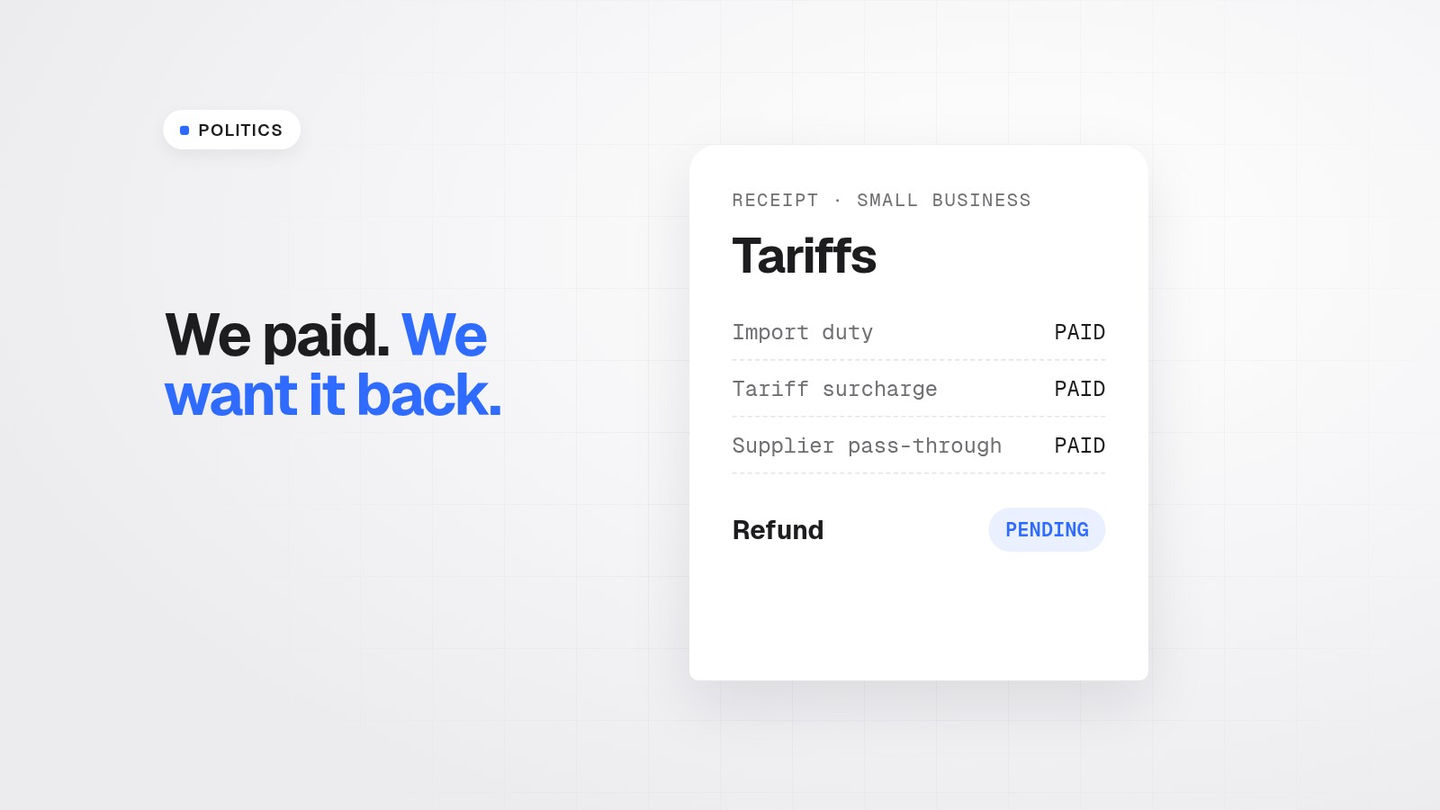
Here's the short version of the tariff story for small businesses. We paid the tariffs, then the courts said they were unlawful, and now we have to do the paperwork to get our own money back.
I'm a Democrat and I oppose these tariffs, so I'll be upfront about my bias. I'll keep the facts and my opinion clearly separate, and every fact below is linked.
What happened (the facts)
The tariffs were struck down. GBH News reported (Nov. 17, 2026) that the Supreme Court ruled the tariffs unlawful and ordered the administration to refund businesses. Those tariffs were in place from April 2025 until February 2026. Grant Thornton notes (Nov. 17, 2026) that the ruling covered President Trump's use of the International Emergency Economic Powers Act (IEEPA). Afterward, the president used a different law, Section 122 of the Trade Act of 1974, to impose a temporary 10% universal tariff.
Small businesses carried a lot of the cost. According to GBH:
- 234,000 small businesses across the country were hit by the tariffs.
- Small businesses make up 97% of U.S. importers.
- An October 2026 report from the Center for American Progress found that firms with fewer than 500 employees bore the brunt of the tariffs and got smaller refunds. In Massachusetts, small businesses paid an average of $151,000 and got back just $53,000.
GBH also profiled Claire Cheney, founder of Curio Spices in Cambridge. She said her business paid about $14,000 in tariffs and applied for $10,000 back, but received only $12.56. CAP's Ryan Mulholland told GBH that result is "uniquely low," but said it reflects a broader process problem.
How the refund process works
U.S. Customs and Border Protection handles refunds through a system called CAPE, which runs inside its online portal, ACE. Per CBP's own page (accessed Nov. 21, 2026):
- You need an ACE Secure Data Portal account, and you need your bank information on file for ACH refunds.
- Only the importer of record or the licensed customs broker who filed the entries can submit a refund request.
- The request is a spreadsheet file (CSV) listing your entry numbers, up to 9,999 per file.
- CBP says valid refunds are generally issued within 60 to 90 days after the request is accepted, unless a compliance concern needs more review.
- The rollout is phased, and some kinds of entries aren't covered yet.
- CBP also warns that scammers are targeting importers with fake refund emails and notices.
If you bought through a third-party importer, that company is the one that files, not you. GBH talked to a Worcester vinegar maker who paid more than $5,000 in tariffs on glass bottles and another $1,100 on pour-tops. He has asked his importer repeatedly for updates and still hasn't received a single dollar back.
There's some good news on the legal side. The Business Journals reported (Nov. 16, 2026) that a recent court order lets tens of thousands of small businesses seek refunds without each filing a separate case.
What Washington is doing
- A refund hotline bill. On Nov. 10, Rep. Gil Cisneros (D-Calif.), with Reps. Analilia Mejia and Kelly Morrison, introduced H.R. 10977, the Small Business Tariff Relief Hotline Act. It would have the SBA's Office of Advocacy set up a hotline for tariff and refund problems and report to Congress every year on what's going wrong (Sandler, Travis & Rosenberg, Nov. 16, 2026). The bill has been referred to the House Small Business Committee.
- A small-business letter. More than 1,200 small businesses signed a letter telling Congress that "the single fastest way" to address affordability "is to roll back tariffs" (Sandler, Travis & Rosenberg).
- Repeal efforts. Grant Thornton reports that Sen. Chuck Schumer's End Trump's Tariff Tax Act (S. 5390) would repeal the Section 122 and Section 338 authorities the president has used. The incoming Democratic majorities, about 260 House seats and 56 Senate seats, can pass bills without Republican votes, but they're well short of the two-thirds needed to override a veto.
- The administration isn't backing down. U.S. Trade Representative Jamieson Greer told CNBC on Nov. 12, "We have to rebalance global trade," and said that wouldn't change after the midterms (quoted by Grant Thornton).
My take
This section is opinion.
A refund you can't actually collect isn't a refund. A big company has a customs team and a trade lawyer. A 10-person shop has the owner, a laptop and whatever time is left after the work is done. Cheney put it best when she told GBH, "We're paying for it twice." Small businesses pay once with money and again with the hours spent on paperwork.
Here's what I'd want the new Congress to push for, starting in January:
- Pass the hotline bill quickly. It's modest, cheap and useful. Use the reports it requires to find out where small importers are getting stuck.
- Make refunds automatic where the government already has the data. CBP knows which entries paid IEEPA duties. Small importers shouldn't have to rebuild that list themselves to get their money back.
- Hold the middlemen accountable. If a broker or third-party importer gets refunded on your behalf, there should be a clear deadline to pass that money on.
- Return trade decisions to Congress. Tariff policy that swings by executive order makes it impossible for small businesses to plan. The uncertainty costs money even when the tariff rate doesn't.
I know a veto is likely on the big repeal bills, so I'm not expecting miracles. But a lot of what small businesses need here is good administration, not sweeping legislation. That's where a Democratic Congress can use oversight and pressure to make a difference quickly.
If your business paid tariffs
Talk to your customs broker or freight forwarder this month. Ask three questions: Were any of my entries subject to IEEPA duties? Has a CAPE declaration been filed for them? When should I expect the money? If you bought through a third party, put those questions in writing.
And remember CBP's warning: watch out for scam emails about refunds.
Sources
- GBH News, "These Mass. businesses are waiting on tariff refunds. Others aren't holding their breath.," Nov. 17, 2026: https://www.wgbh.org/news/local/2026-11-16/these-mass-businesses-are-waiting-on-tariff-refunds-others-arent-holding-their-breath
- U.S. Customs and Border Protection, "IEEPA Duty Refunds," accessed Nov. 21, 2026: https://www.cbp.gov/trade/programs-administration/trade-remedies/ieepa-duty-refunds
- The Business Journals, "Court backs small-business owners for access to billions in tariff refunds," Nov. 16, 2026: https://www.bizjournals.com/bizjournals/news/2026/11/16/tariff-refunds-class-action-lawsuit-cape.html
- GovInfo, "H.R. 10977 (IH) – Small Business Tariff Relief Hotline Act," Nov. 10, 2026: https://www.govinfo.gov/app/details/BILLS-119hr10977ih
- Sandler, Travis & Rosenberg, "Legislative Update: Tariffs, Imports," Nov. 16, 2026: https://www.strtrade.com/trade-news-resources/str-trade-report/november/legislative-update-tariffs-imports-2
- Grant Thornton, "Administration to continue tariff policy post-midterms," Nov. 17, 2026: https://www.grantthornton.com/insights/newsletters/tax/2026/hot-topics/nov-17/administration-to-continue-tariff-policy-post-midterms
Keep reading
All articles
One email. Every Sunday.
The week in business, markets and politics, in five minutes.