Nvidia Doubled Its Revenue. The Stock Still Fell. Here's Why.
Record results ran into a CEO scandal, China export rules and reported investigations.

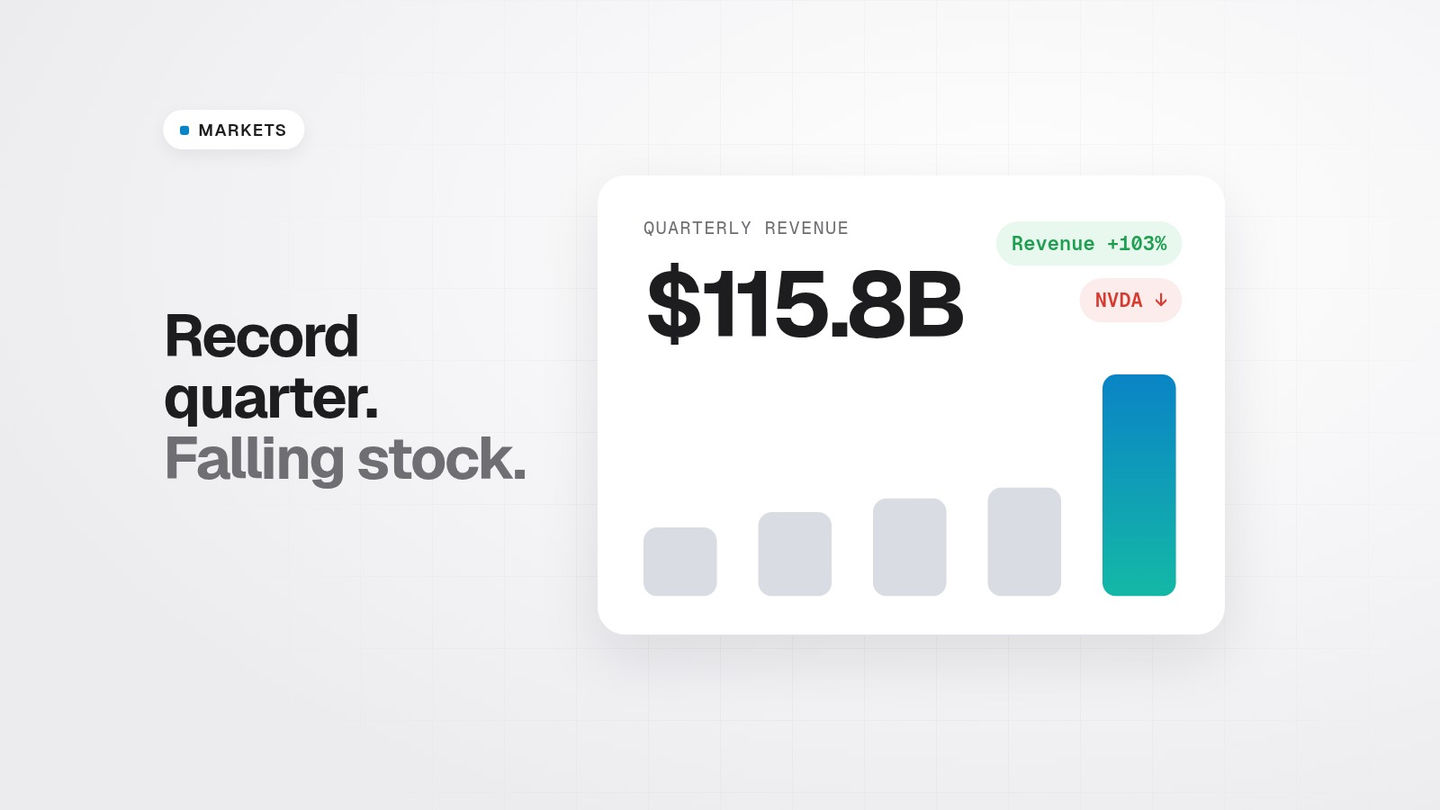
If you only read the press release, you'd think Nvidia just had the best week in its history. Revenue doubled, it raised its outlook, and a new chip platform is shipping faster than any product the company has made.
The stock went the other way. To understand why, you have to look past the income statement.
The quarter, by the numbers
From Nvidia's earnings release, for the quarter that ended Oct. 25, 2026:
- Revenue: $115.8 billion, up 20% from the prior quarter and up 103% from a year earlier.
- Data center revenue: $107.6 billion, up 110% from a year earlier. Data centers are now almost the whole company.
- Gross margin: 74.8% on a GAAP basis.
- Earnings per share: $2.68 on an adjusted basis. According to LSEG estimates cited by CNBC, Wall Street expected $2.48 per share and $109.10 billion in revenue.
- Cash returned to shareholders: $28.1 billion in buybacks and dividends during the quarter.
Nvidia also said its new Vera Rubin NVL72 platform is shipping, calling it "the fastest product ramp in the company's history."
The guidance was strong too
For the current quarter, Nvidia guided to $130 billion in revenue, plus or minus 3%. That quarter has an extra week. The company also said it is "not assuming any Data Center compute revenue from China in its outlook" (Nvidia, Nov. 17, 2026).
Going into the call, the big question was whether Nvidia would walk back its forecast of 70% growth for the fiscal year ending in January 2028. It raised it to 75% instead (CNBC, Nov. 17, 2026).
In most quarters, numbers like these would send the stock sharply higher. After hours on Tuesday it was up more than 3%. By Friday, according to CNBC's market wrap (Nov. 20, 2026), Nvidia was down about 14% as the whole AI trade sold off.
Why the stock fell anyway
1. The CEO is gone
Co-founder Jensen Huang resigned abruptly as CEO the week before earnings. CFO Colette Kress is now interim CEO. At the start of the earnings call, board chair Harvey Jones said the board doesn't intend to bring Huang back (CNBC, Nov. 17, 2026). CNBC also reported that Nvidia hired the law firm Wachtell Lipton to investigate Huang's conduct, and whether it compromised national security or company secrets.
I'm sticking to what's been reported and confirmed here. The details around Huang's exit are still being investigated, and I'm not going to speculate about them.
Investors are pricing in what losing a founder means. CNBC reported that more than 20 analysts tracked by FactSet cut their price targets on Nvidia in a nine-day stretch. One was Mizuho, which lowered its target to $220 from $250 and said the leadership change "adds a 6-7-month management overhang."
2. China got harder
CNBC reported that on Monday, Nov. 16, the Commerce Department announced a change that would block Nvidia's chips from being rented to Chinese companies entirely, which puts that revenue at risk. Nvidia already leaves China data center revenue out of its outlook. The bigger question now is how much tighter the rules get.
3. The investigations
On Thursday, Nov. 19, California Attorney General Rob Bonta sent Nvidia an investigative subpoena. In a statement quoted by CNBC, Bonta said his office is investigating "whether Nvidia or [former CEO] Jensen Huang's actions resulted in China obtaining advanced chips or confidential information – and if Nvidia misled investors and the public about this risk." On Friday, CNBC said the selling picked up after Reuters reported that the SEC is exploring possible accounting issues at the company.
Investigations aren't conclusions. They do add uncertainty, and the market doesn't like uncertainty in its biggest stocks.
4. The whole AI trade is repricing
Nvidia didn't fall alone. In the same Friday wrap, CNBC had AMD down more than 13% and Micron almost 14%. As I wrote in my breakdown of the week's sell-off, the Fed is expected to raise rates in December, and that weighs on every high-growth stock.
What Nvidia's interim CEO said
Kress told CNBC's Jim Cramer that "the most important thing we have seen is growth in the demand that's out there," and on the earnings call she said it's "business as usual at Nvidia" (CNBC, Nov. 17, 2026). The numbers back her up on demand. What she can't settle yet is who leads the company long term.
My take as a business owner
There's a lesson here that applies to a five-person shop as much as to a $100-billion-a-quarter company. Key-person risk is real. If your business only runs because of you, its value depends on you, and on everything you do.
Nvidia has a deep bench, a strong product lineup and demand that, by its own account, is still running ahead of supply. Even so, the market immediately discounted the stock when the founder left. If you're building something, document your processes, train your people and make the company bigger than any one person. That includes you.
What I'm watching
- A permanent CEO. The sooner Nvidia names one, the sooner the "management overhang" Mizuho described can start to lift.
- The China rules. Watch whether the new Commerce restrictions expand.
- The investigations. Watch whether the reported SEC inquiry and the California subpoena turn into anything formal.
- Next quarter. Watch whether Nvidia actually delivers the roughly $130 billion it guided to.
This post is for information and commentary only. It isn't financial advice. Do your own research or talk to a licensed professional before you invest.
Sources
- NVIDIA, "NVIDIA Announces Financial Results for Third Quarter Fiscal 2027," Nov. 17, 2026: https://investor.nvidia.com/news/press-release-details/2026/NVIDIA-Announces-Financial-Results-for-Third-Quarter-Fiscal-2027/
- CNBC, "Nvidia (NVDA) Q3 2027 earnings report" (live coverage), updated Nov. 18, 2026: https://www.cnbc.com/2026/11/17/nvidia-nvda-earnings-report-q3-2027.html
- CNBC, "Stock market news for Nov. 20, 2026," including the Nov. 19 item on the California AG's subpoena: https://www.cnbc.com/2026/11/19/stock-market-today-live-updates.html
Keep reading
All articles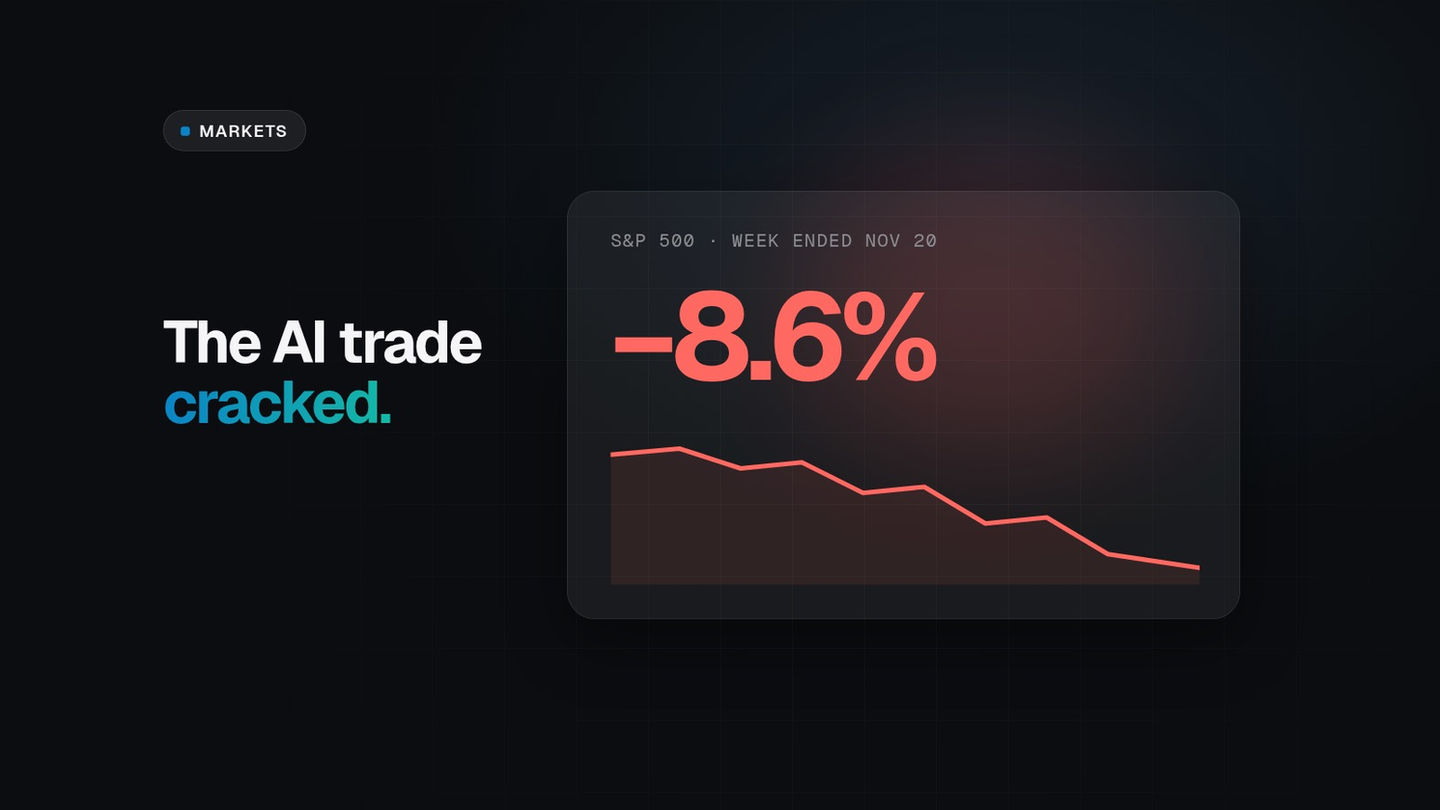

One email. Every Sunday.
The week in business, markets and politics, in five minutes.