The AI Trade Just Had Its Worst Week in Years. Here's What I'm Watching.
A record IPO, a CEO exit at Nvidia and a hawkish Fed all landed in the same five days.

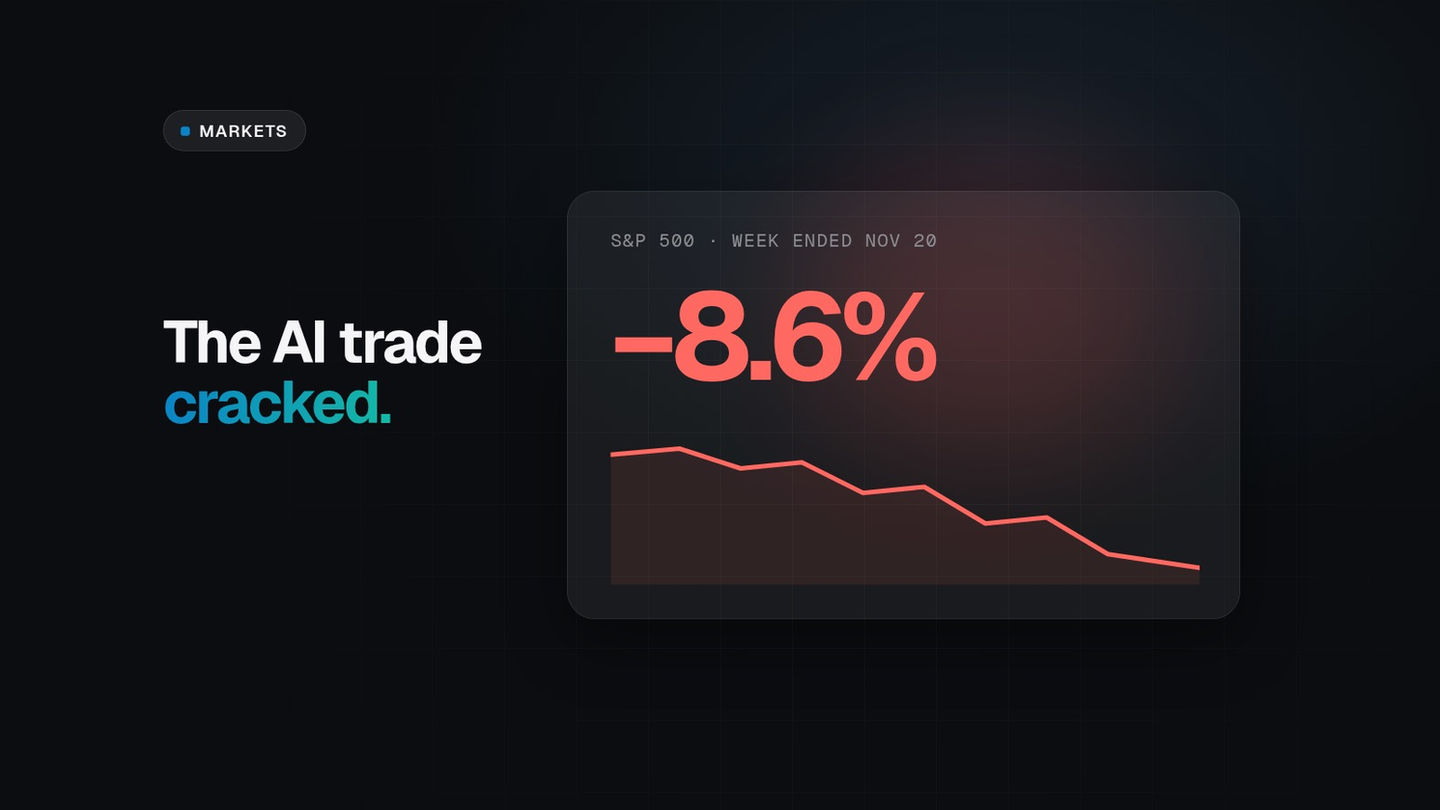
Last week, the market had everything the AI bulls asked for: a record-breaking IPO from Anthropic and blowout earnings from Nvidia. Stocks still had their worst week in years.
When the good news can't lift prices, it tells you the market has stopped asking "how big can this get?" and started asking "who's paying for it, and at what interest rate?" Here's how I read it.
The numbers from Friday
The worst of it came on Friday, Nov. 20. According to CNBC's market wrap (as of the Nov. 20 close):
- The S&P 500 dropped 3.7% to 6,910.39.
- The Nasdaq Composite fell 5.28% to 22,617.73. That puts it 2.7% down for 2026.
- The Dow lost 949.73 points, or 1.93%, to finish at 48,147.33.
- The S&P 500 and the Dow both closed 10% below their records, which puts them officially in correction territory.
- The Nasdaq-100 fell 5.6% and was briefly in a bear market during the day, 20% below its recent high.
For the week, CNBC said the Dow had its worst week since March 2020 and the Nasdaq had its biggest one-week drop in more than six years. T. Rowe Price's weekly update (Nov. 20, 2026) puts the Nasdaq's weekly loss at 10.02%. It says information technology and communication services fell hardest, while consumer staples and utilities held up best.
Fear showed up in the numbers too. The VIX, Wall Street's main volatility gauge, reached 32.27 during Friday's session. CNBC noted the index hadn't closed above 30 since late March.
Why good AI news didn't help
On paper, this should have been a strong week for AI.
Anthropic went public. It priced its IPO at $83 a share and raised $81.3 billion, the largest IPO on record (CNBC, Nov. 18, 2026). The stock rose 17% on its first day of trading, Thursday, then fell 8.5% on Friday (CNBC, Nov. 20, 2026).
Nvidia posted a huge quarter. Revenue came in at $115.8 billion, up 103% from a year earlier (Nvidia, Nov. 17, 2026). The company also raised its outlook. I break that report down in a separate post.
Investors sold anyway. In CNBC's Friday wrap, AMD slid more than 13%, Nvidia about 14% and Micron almost 14%. CNBC also said selling picked up after Reuters reported that the SEC is looking into possible accounting issues at Nvidia. That's a report, not a finding, and I'm treating it that way.
CNBC listed the other headwinds as signs that capital spending is slowing, Democratic wins in the midterms, and Jensen Huang's exit as Nvidia CEO. Taken together, those raised questions about how long the AI buildout can keep its pace. Richard Saperstein of Treasury Partners told CNBC the market is going through "an AI repricing."
My read: the AI story isn't over, but the market has stopped paying any price for it. When a company has a great quarter and its stock still drops double digits in a week, investors are reconsidering how much those earnings are worth, not doubting that the earnings are real.
The Fed is raising rates, not cutting them
This is the part I think people underrate.
At its Oct. 28 meeting, the Federal Reserve held its benchmark rate at 3.75% to 4%. The vote was 10 to 2, and both dissenters, Lisa Cook and Beth Hammack, wanted a quarter-point hike (Oct. 28, 2026). T. Rowe Price (Nov. 20, 2026) summarized the meeting minutes, released last Wednesday. They showed that almost all officials expect more rate increases will likely be appropriate. Governor Christopher Waller said a half-point hike in December could be appropriate.
On Friday, Cook said "waiting longer to implement rate increases risks getting behind the curve" (CNBC, Nov. 20, 2026). CNBC reported that markets strongly expect a quarter-point hike at the Dec. 8–9 meeting.
Higher rates hit the AI trade in two ways. They lower the present value of profits that are years away, and they make it more expensive to borrow the billions it takes to build data centers. CNBC's Anthropic IPO coverage said the market was already worried that rising rates would make that debt unaffordable for many data center developers.
Where money went instead
When investors get scared, they buy things people need no matter what. On Friday, Walmart gained more than 1%, and Costco, Johnson & Johnson and Procter & Gamble each rose about 1% (CNBC, Nov. 20, 2026). That's the classic defensive move.
What I'm watching next
- The Fed on Dec. 8–9. A quarter-point hike is what markets expect. If the Fed goes bigger, or sounds more hawkish than expected, that matters more than any single earnings report.
- Whether the selling spreads. BTIG's Jonathan Krinsky pointed out that all three major indexes were trading below their 200-day moving averages, and said, "Generally speaking once something is below a 200 DMA, the risk is to the downside" (CNBC, Nov. 20, 2026).
- Nvidia's leadership and the investigations. Until there's a permanent CEO and clarity on the reported probes, that uncertainty sits over the most important stock in the AI trade.
The small-business takeaway
I'm co-owner of a small Houston agency, not a hedge fund manager. Still, a week like this matters to people like me. Rate hikes make every business loan, credit line and equipment lease more expensive. If you're planning to borrow in 2027, run the numbers at a higher rate now, not later.
And if you own index funds through a 401(k) or an IRA, remember what an index fund is: you own the whole market, not just AI. I don't make any decisions based on one bad week, and I don't think you should either.
This post is for information and commentary only. It isn't financial advice. Do your own research or talk to a licensed professional before you invest.
Sources
- CNBC, "S&P 500 and Dow close in correction; Nasdaq erases 2026 gain as AI rout picks up steam," Nov. 20, 2026: https://www.cnbc.com/2026/11/19/stock-market-today-live-updates.html
- T. Rowe Price, "Global Markets Weekly Update," Nov. 20, 2026: https://www.troweprice.com/en/us/insights/global-markets-weekly-update
- CNBC, "Anthropic IPO raises over $81 billion in largest offering on record," Nov. 18, 2026: https://www.cnbc.com/2026/11/18/anthropic-ipo-ai-offering-price.html
- NVIDIA, "NVIDIA Announces Financial Results for Third Quarter Fiscal 2027," Nov. 17, 2026: https://investor.nvidia.com/news/press-release-details/2026/NVIDIA-Announces-Financial-Results-for-Third-Quarter-Fiscal-2027/
- Federal Reserve, "Federal Reserve issues FOMC statement," Oct. 28, 2026: https://www.federalreserve.gov/newsevents/pressreleases/monetary20261028a.htm
Keep reading
All articles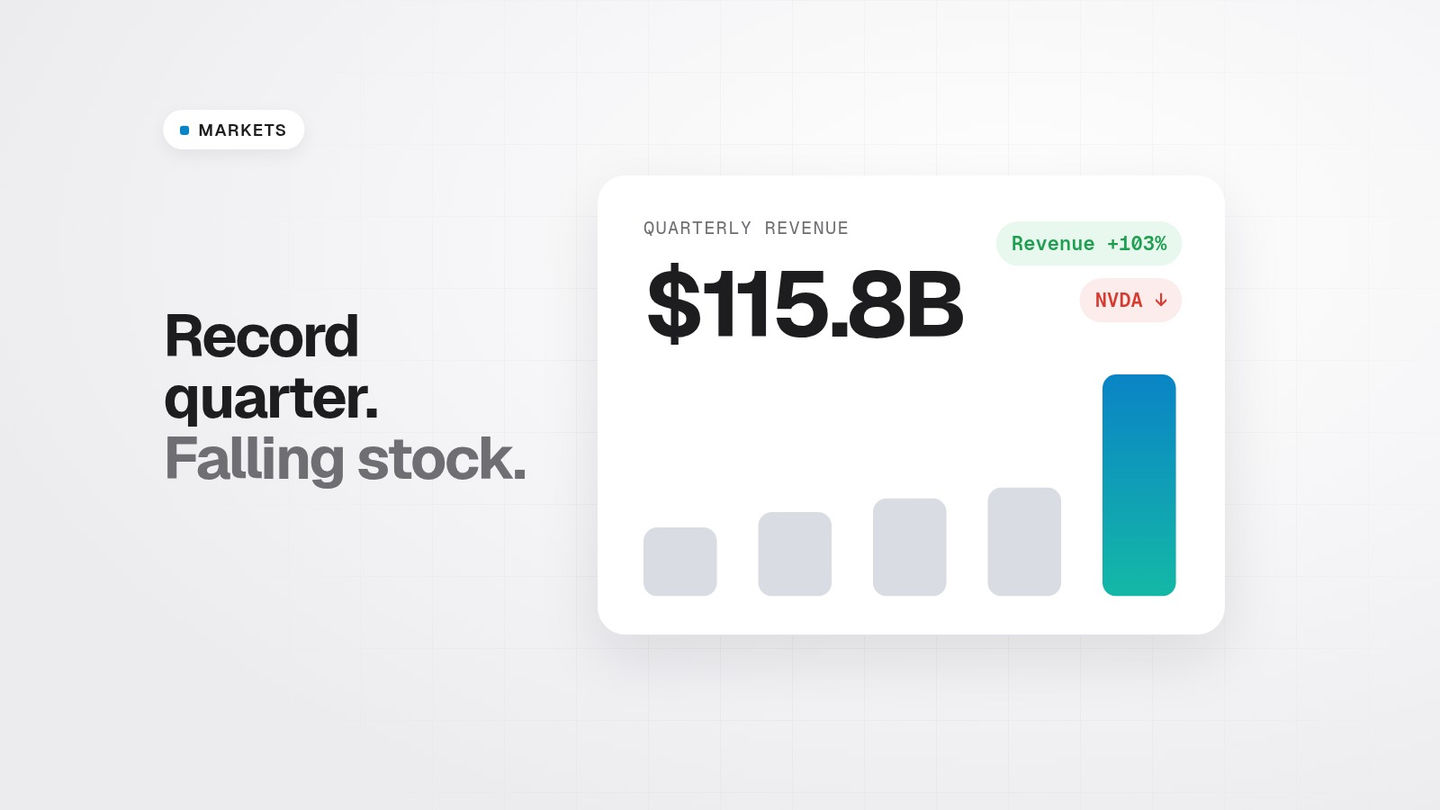

One email. Every Sunday.
The week in business, markets and politics, in five minutes.